640 mm on a ruler
640 mm on a ruler is 64 cm, 640 mm and 25.197 inches from zero. The blue line on the left ruler ends at that length.
Rest the object on the zero line. Hover the ruler, or drag on the blank area to measure between two points.
Ruler diagram
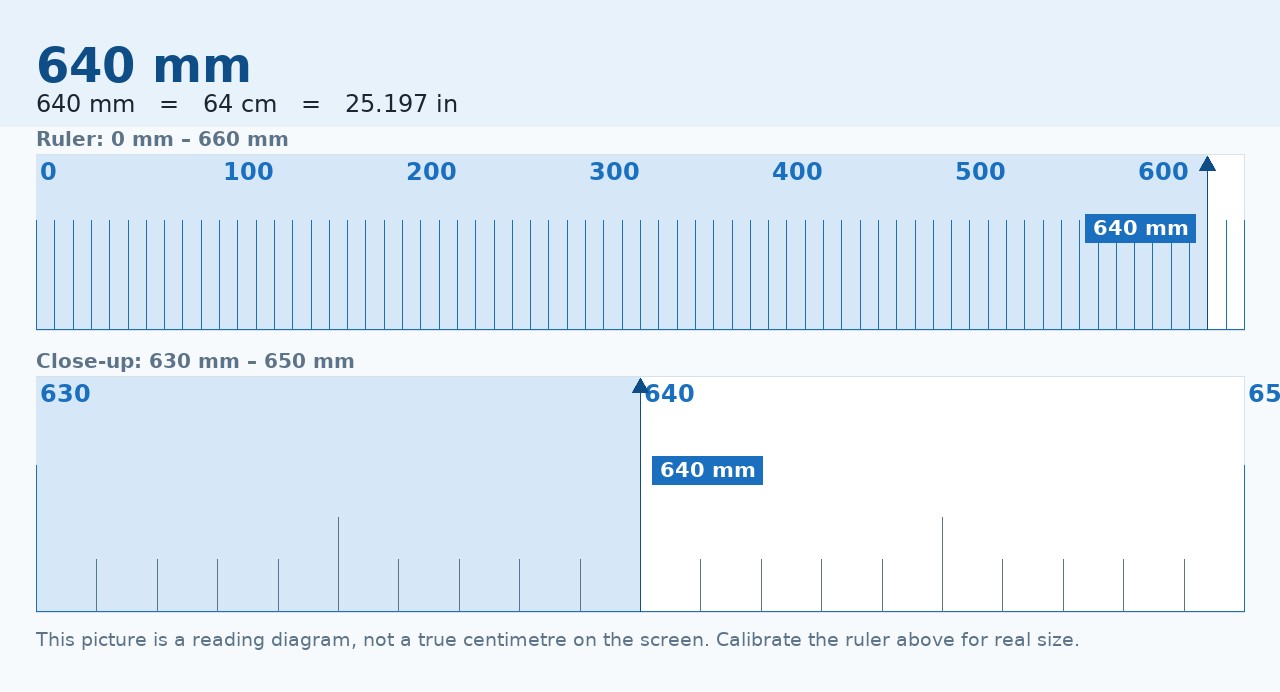
Where 640 mm sits on the ruler
The blue band runs from zero to this mark. If it passes the screen, scroll the horizontal ruler. A narrow phone does not shrink the scale; the mark simply sits further along. The left ruler stays fixed as soon as the page opens.
The long centimetre line numbered 64 is 640 mm. 640 mm lands on that line; one short tick to the right would add 1 mm.
The nearest inch division is 25 3/16. 640 mm is 0.24 mm away from it.
640 mm overshoots a 30 cm ruler by 34 cm. If the mark is past the first screen, scroll the horizontal ruler; the scale does not shrink.
640 mm is past a school ruler. The reference is 1 metre; this length is 360 mm shorter. Mark a long strip in 20 cm pieces so the error stays small.
640 mm is 64 percent of a metre. A 1 metre strip yields 1 whole pieces, with 36 cm left over.
640 mm is 34.3 cm longer than the long side of A4 paper (29.7 cm). That object is 46.4 percent of this length.
In CSS, 1 inch is 96 pixels. 640 mm is about 2418.9 pixels. The same length is about 7559 pixels at 300 dpi and about 1814.2 pt. These are CSS and print references, not the physical resolution of the screen.
Missing 640 mm by 1 mm is an error of 0.16 percent. Seat the object on the zero line and look straight down; a slanted glance makes the mark look longer.
For scale, the long edge of a bank card is 85.6 mm and the short edge of A4 paper is 210 mm.
- 1. Find the 0 mark at the top of the left ruler. Rest one edge of the object on that line.
- 2. The long blue marks are centimetres. Ten short gaps sit between them, and each gap is 1 millimetre.
- 3. Stop on the long mark labelled 64. That line is the length.
- 4. Match a bank card once so this screen shows a real centimetre. Keep the browser zoom at 100%.
The length in numbers
- Centimetres
- 64 cm
- Millimetres
- 640 mm
- Inches and nearest fraction
- 25.197 in · 25 3/16
- Place on the ruler
- on the long line marked 64 cm
- Millimetres from zero
- 640
- Share of 1 metre
- 64 percent
- CSS pixels (96 dpi)
- 2418.9
- Points
- 1814.2
- Share of a 1 mm miss
- 0.16 percent
How many times it fits
| Object | Reference | Times | Left over |
|---|---|---|---|
| the long side of A4 paper | 29.7 cm | — | 34.3 cm longer |
| 1 metre | 100 cm | 1 | 36 cm |
Conversion
| Unit | Value |
|---|---|
| Centimetres | 64 cm |
| Millimetres | 640 mm |
| Inches | 25.197 in |
Half, double, and neighbours
If the ruler is not true to size, open calibration.
Questions
Where is 640 mm on a ruler on a ruler?
640 mm on a ruler is 64 cm, 640 mm and 25.197 inches from zero. The blue line on the left ruler ends at that length.
What is 640 mm on a ruler in the other units?
640 mm on a ruler equals 64 cm = 25.197 Inches.
Is 640 mm on a ruler true to size on the screen?
After you match a card, the blue line is that real length on this screen. A browser cannot read physical millimetres, so the first scale is only an estimate. Keep zoom at 100%.
How many pixels is 640 mm?
In CSS, 1 inch is 96 pixels. 640 mm is about 2418.9 pixels. The same length is about 7559 pixels at 300 dpi and about 1814.2 pt. These are CSS and print references, not the physical resolution of the screen.
Does 640 mm fit on a 30 cm ruler?
640 mm overshoots a 30 cm ruler by 34 cm. If the mark is past the first screen, scroll the horizontal ruler; the scale does not shrink.
How large is a 1 mm miss when reading 640 mm?
Missing 640 mm by 1 mm is an error of 0.16 percent. Seat the object on the zero line and look straight down; a slanted glance makes the mark look longer.