502 mm on a ruler
502 mm on a ruler is 50.2 cm, 502 mm and 19.764 inches from zero. The blue line on the left ruler ends at that length.
Rest the object on the zero line. Hover the ruler, or drag on the blank area to measure between two points.
Ruler diagram
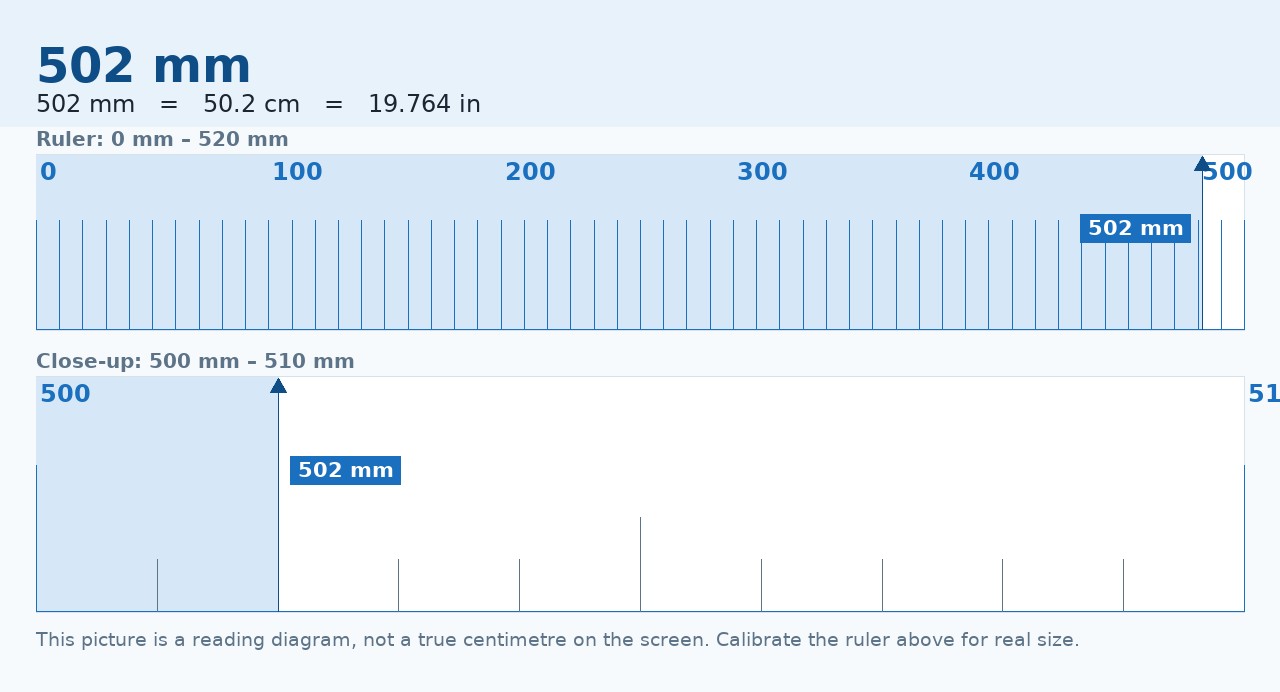
Where 502 mm sits on the ruler
The blue band runs from zero to this mark. If it passes the screen, scroll the horizontal ruler. A narrow phone does not shrink the scale; the mark simply sits further along. The left ruler stays fixed as soon as the page opens.
Count 2 mm short steps past the 50 cm line. 502 mm is that tick. The 5 mm line is another 3 mm to the right; do not pass it.
The nearest inch division is 19 3/4. 502 mm is 0.35 mm away from it.
502 mm overshoots a 30 cm ruler by 20.2 cm. If the mark is past the first screen, scroll the horizontal ruler; the scale does not shrink.
502 mm is past a school ruler. The reference is 1 metre; this length is 498 mm shorter. Mark a long strip in 20 cm pieces so the error stays small.
502 mm is 50.2 percent of a metre. A 1 metre strip yields 1 whole pieces, with 49.8 cm left over.
502 mm is 20.5 cm longer than the long side of A4 paper (29.7 cm). That object is 59.2 percent of this length.
In CSS, 1 inch is 96 pixels. 502 mm is about 1897.3 pixels. The same length is about 5929 pixels at 300 dpi and about 1423 pt. These are CSS and print references, not the physical resolution of the screen.
Missing 502 mm by 1 mm is an error of 0.2 percent. Seat the object on the zero line and look straight down; a slanted glance makes the mark look longer.
Compare it with the long side of A4 paper, which is 297 mm. This mark is 205 mm longer.
- 1. Find the 0 mark at the top of the left ruler. Rest one edge of the object on that line.
- 2. The long blue marks are centimetres. Ten short gaps sit between them, and each gap is 1 millimetre.
- 3. Go to the long mark labelled 50, then count 2 millimetres further.
- 4. Match a bank card once so this screen shows a real centimetre. Keep the browser zoom at 100%.
The length in numbers
- Centimetres
- 50.2 cm
- Millimetres
- 502 mm
- Inches and nearest fraction
- 19.764 in · 19 3/4
- Place on the ruler
- 2 mm past the 50 cm line
- Millimetres from zero
- 502
- Share of 1 metre
- 50.2 percent
- CSS pixels (96 dpi)
- 1897.3
- Points
- 1423
- Share of a 1 mm miss
- 0.2 percent
How many times it fits
| Object | Reference | Times | Left over |
|---|---|---|---|
| the long side of A4 paper | 29.7 cm | — | 20.5 cm longer |
| 1 metre | 100 cm | 1 | 49.8 cm |
Conversion
| Unit | Value |
|---|---|
| Centimetres | 50.2 cm |
| Millimetres | 502 mm |
| Inches | 19.764 in |
Half, double, and neighbours
If the ruler is not true to size, open calibration.
Questions
Where is 502 mm on a ruler on a ruler?
502 mm on a ruler is 50.2 cm, 502 mm and 19.764 inches from zero. The blue line on the left ruler ends at that length.
What is 502 mm on a ruler in the other units?
502 mm on a ruler equals 50.2 cm = 19.764 Inches.
Is 502 mm on a ruler true to size on the screen?
After you match a card, the blue line is that real length on this screen. A browser cannot read physical millimetres, so the first scale is only an estimate. Keep zoom at 100%.
How many pixels is 502 mm?
In CSS, 1 inch is 96 pixels. 502 mm is about 1897.3 pixels. The same length is about 5929 pixels at 300 dpi and about 1423 pt. These are CSS and print references, not the physical resolution of the screen.
Does 502 mm fit on a 30 cm ruler?
502 mm overshoots a 30 cm ruler by 20.2 cm. If the mark is past the first screen, scroll the horizontal ruler; the scale does not shrink.
How large is a 1 mm miss when reading 502 mm?
Missing 502 mm by 1 mm is an error of 0.2 percent. Seat the object on the zero line and look straight down; a slanted glance makes the mark look longer.